The bundle keeps the build brief and style notes together.
Inspired by Binance.com
Biscuit Exchange
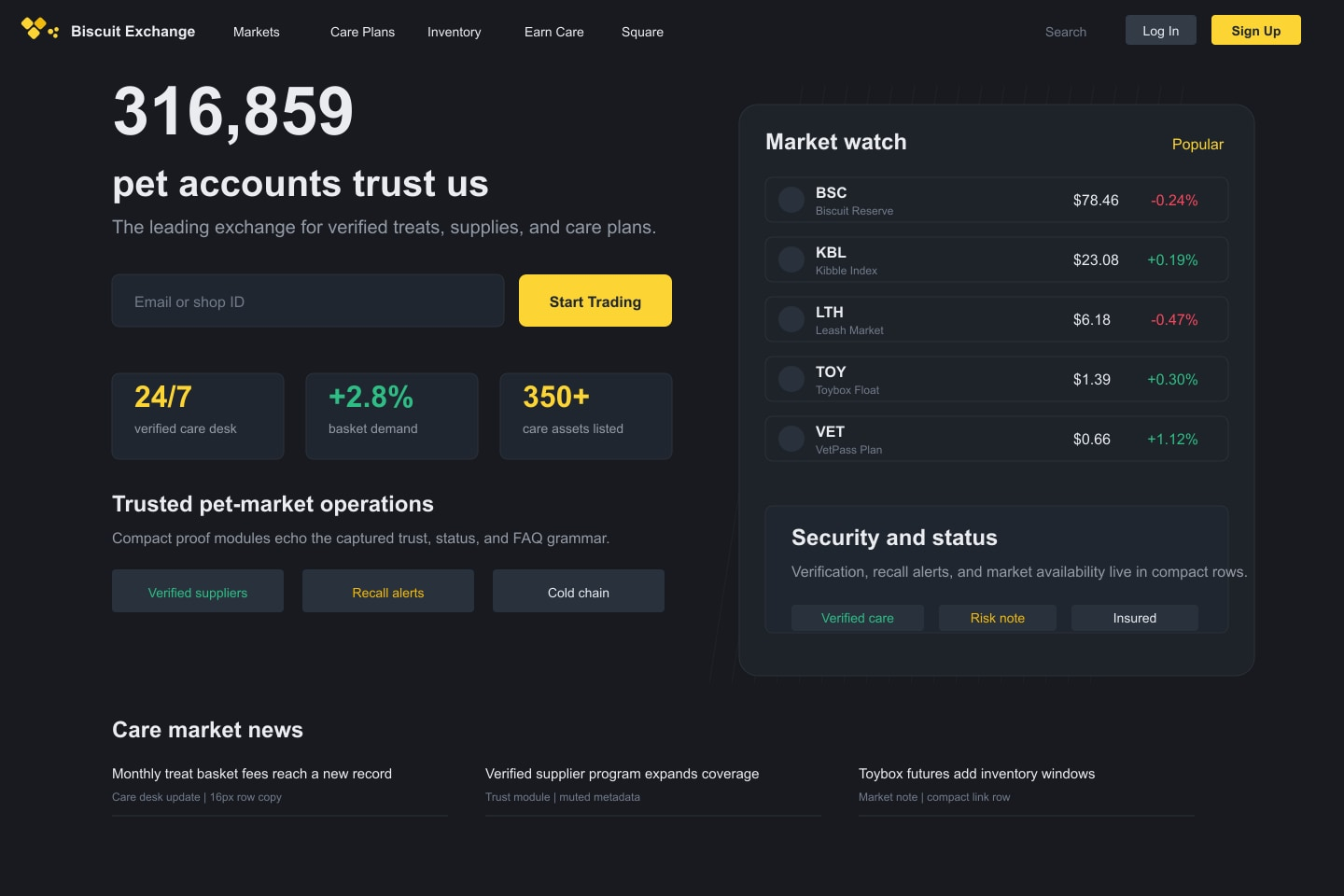
A dark, high-density exchange system translated into a fictional pet shop marketplace. Evidence comes from the local www-binance-com dossier captured on 2026-05-02, including dark charcoal surfaces, BinanceNova/BinancePlex typography, yellow primary actions, compact asset rows, tabbed markets, status deltas, account-start inputs, cookie dialogs, switches, and a dense footer.
darkdensedashboardtechnicalexchangeweb3-dashboard
Implementation bundle
Copy one clean packet, or just the pieces you need.
Copy the full bundle when you want an agent to build in this style. Use the individual files when you only need tokens, CSS, Tailwind, or component prompts.
Use CSS variables, Tailwind values, and JSON tokens when you need exact values.
Component prompts describe reusable patterns. Keep weak areas marked limited or unavailable.
# Biscuit Exchange Implementation Bundle

Use this as the build brief for an AI coding agent. The base remix prompt tells the agent what to make; the style kit adds evidence, component behavior, and known limits.

## Base Remix Prompt

Build an interface using the Binance.com-inspired Biscuit Exchange style kit.

Use a dark high-density exchange system backed by the local `www-binance-com` design dossier: `#181a20` shell, `#202630`/`#29313d`/`#333b47` panels, `#eaecf0` text, muted `#929aa5`/`#707a8a` labels, `#fcd535` primary actions, `#f0b90b` yellow accents, `#2ebd85` positive status, and `#f6465d` negative/warning status.

Use the kit strongly for: overall style, color system, typography, layout, navigation, hero, buttons, cards, tabbed asset lists, badges/status, menus/modals, and interaction states.

Preserve the extracted grammar: 64px header; compact 14px nav labels; a trust-metric hero; account-start/search inputs; yellow signup actions; 40px tablists with selected/unselected states; 16px asset rows with symbols, names, prices, and deltas; right-aligned figures; compact news/status cards; checked switches; cookie/dialog-style confirmation actions; and dense footer groupings.

For the fictional pet shop translation, turn exchange assets into pet-care inventory assets such as Biscuit, Kibble, Leash, Toybox, VetPass, and Grooming. Use market rows for price, reorder, availability, adoption, or care-plan movement. Use trust modules for verified suppliers, recall alerts, insured delivery, and account protection.

This kit has limited evidence for complete form systems, full trading charts, wallet transactions, loading/empty/error states, and long approval flows. For forms, borrow only account-start and search treatments unless another selected kit owns complete forms. For charts, use compact metric blocks and market deltas rather than inventing a full analytics suite.

Image generation prompt: dark fictional pet marketplace product scene, charcoal panels, trading-yellow highlights, abstract market grid, compact device mockups, small pet-care inventory icons, cool-gray surfaces, secure premium finance mood, no logos, no readable source text, no source screenshots, no watermark.


## Agent Kit

# Binance.com Pet Shop Agent Kit

This kit translates the Binance.com homepage capture into a fictional pet shop marketplace called Biscuit Exchange. It is evidence-backed by the local dossier at `design-dossier/design-dossiers/www-binance-com`, captured from `https://www.binance.com/` on `2026-05-02T16:05:29.837Z`.

Use it when you want a dark, secure, high-density exchange interface: charcoal surfaces, trading-yellow primary actions, compact navigation, tabbed asset lists, market deltas, trust/status modules, account-start flows, cookie/dialog controls, switches, and dense footer systems.

## Evidence Anchors

- Source dossier: `DESIGN.md`, `components.md`, `product-patterns.md`, `tokens.json`, `evidence.json`.
- Viewports: desktop `1440x1100`, mobile `390x844`.
- Colors: `#181a20` shell, `#202630`/`#29313d`/`#333b47` panels, `#eaecf0` primary text, `#929aa5` and `#707a8a` muted text, `#fcd535` and `#f0b90b` yellow actions/accents, `#2ebd85` positive states, `#f6465d` negative states.
- Typography: `BinanceNova, Arial, sans-serif` dominates the capture; `BinancePlex, Arial, sans-serif` appears in dialog/button contexts. Repeated sizes include `72px`, `40px`, `24px`, `20px`, `16px`, `14px`, and `12px`.
- Layout: desktop hero starts around `x=120`; right-side market/news rows start around `x=864` and are `432px` wide. Mobile uses `16px` gutters and `358px` content width.
- Components: 64px global header, 14px/500 nav labels, 32px small header buttons, 48-56px large signup buttons, 40px tablists with 24px gaps, repeated asset rows, status deltas, consent dialog buttons, checked switches, FAQ rows, and a 67-link footer inventory.

## Visual Direction

- Build a near-black app shell instead of a marketing page.
- Use yellow only for important actions, selected states, and small trust/brand accents.
- Keep surfaces mostly flat: panel separation comes from `#2b3139` borders, muted fills, and sparse shadows.
- Pair a large trust-metric hero with a compact operational console.
- Use right-aligned numbers, small deltas, and terse status labels.
- Let mobile stack the same modules with tight gutters and a strong top signup action.

## Component Grammar

- Navigation: dense global header with product groups, search, account actions, utility icons, dropdown affordances, and dense footer links.
- Hero: trust metric, short marketplace promise, account-start input, yellow CTA, and market/news companion module.
- Tables: tabbed asset lists with identity icon, symbol/name, price, movement delta, muted dividers, and right-aligned figures.
- Cards: dark market, news, trust, app/device, FAQ, and account modules. Prefer 4-10px control radii and 8px card radii unless copying a captured 20-24px panel treatment.
- Forms: account-start and search fields only. This kit does not prove long checkout or profile forms.
- Badges: market deltas, verification, risk, availability, and account status.
- Menus: compact dark dropdowns, tab menus, switches, and consent-style dialogs.
- Charts: limited. Use metrics, deltas, and small trend cues rather than full trading charts.

## Fictional Pet Shop Translation

Replace crypto assets with pet-market inventory assets while preserving the evidence-backed structure:

- Coins become products or care assets: `BSC Biscuit`, `KBL Kibble`, `LTH Leash`, `TOY Toybox`, `VET VetPass`.
- Market prices become basket price, reorder value, stock movement, or adoption velocity.
- Trust/security modules become verified supplier care, recall alerts, cold-chain status, insured delivery, or account protection.
- News modules become care-market updates, supplier notices, or adoption program announcements.
- Footer links become shop, care, business, learning, and support inventories.

## Image Direction

Use generated fictional product imagery only: dark device mockups, abstract market grids, simple pet-care inventory icons, yellow highlights, and cool-gray panels. Do not use source screenshots, Binance logos, readable source text, trademarks, or proprietary brand marks.

## Best Use Cases

- Exchange-like pet inventory marketplaces
- Dense dashboards and portfolio/watchlist surfaces
- Secure account onboarding
- Status-heavy operations panels
- Mobile-first finance-style product tools